Basic HTML Version


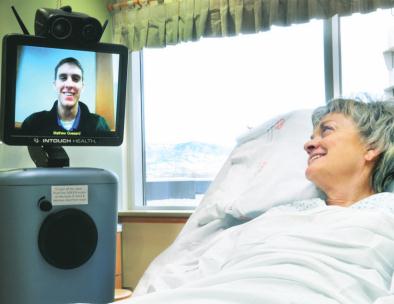
EVER TRIED
A TELEVISIT?
Both Ontario and Baker
City medical centers have
an innovative program that
enables us to serve patients
in a new way. The Saint
Alphonsus TeleVisit program
allows family and friends
to be virtually present at a
loved one’s bedside, interact-
ing face to face in real time,
when circumstances make
it otherwise impossible to
be present. For example,
if a patient had to travel to
Saint Alphonsus in Boise for
specialized care, family in
Ontario or Baker could keep
connected via a specialized
TeleVisit computer. Whether it
is distance, financial ability or
medical reason keeping you
and your hospitalized loved
one apart, we will help bring
you together.
IT’S AMAZING WHAT
digital technology
can do these days. In our everyday lives,
we can share snapshots immediately with
friends or use a webcam to see and hear
distant relatives. In a similar way, the Saint
Alphonsus Teleneurology Stroke Program
gives emergency departments at community
hospitals the opportunity for direct,
immediate video consultation with stroke
experts at Idaho’s only Joint Commission-
certified primary stroke care center.
Telestroke uses a state-of-the-art robotic
system and a web connection to link rural
emergency departments to stroke special-
ists whenever their expertise is needed.
Without being physically at the hospital,
the specialists can examine and speak with
stroke patients and consult with physicians
by using equipment that includes a webcam
and video screen. Neurologists backed by a
specially trained team of certified healthcare
professionals are available 24 hours a day,
365 days a year.This is essential because time
is crucial when someone is having a stroke.
Anatomy of a stroke
Most strokes happen when a clot blocks
blood flow to the brain, robbing its cells
of oxygen they need. A clot-busting drug
called TPA (tissue plasminogen activator)
can restore blood flow and help prevent dis-
ability in people who have these strokes. But
it must be given within three hours of the
onset of symptoms and only after doctors
determine whether the patient is a candidate
for TPA. Making that decision requires a
consultation from a neurologist with special
training to manage stroke patients.
That’s where the Saint Alphonsus Tele-
neurology Stroke Program comes in. When
a person who may be having a stroke arrives
at the emergency department, doctors can
activate the secure system to connect with
a neurologist. Using the robotic system,
the neurologist can see and hear the patient
and emergency department doctor (and
vice versa), perform a stroke exam, review
brain scans, take a patient history, and work
with the emergency physician. The result
is a swift determination as to whether TPA
or other treatments are needed. This allows
treatment to begin in the rural emergency
department, even before transfer to Saint
Alphonsus. Early treatment has been shown
to improve outcomes and decrease the long-
term effects from stroke.
A dedication to stroke response
Ranked No. 1 in Idaho for the treatment of
stroke by HealthGrades
®
, the Saint Alphon-
sus Primary Stroke Care Center is the only
center in the region that offers the full con-
tinuum of comprehensive care for stroke
patients where we focus on immediate treat-
ment. FromLife Flight air medical transport
to a dedicated stroke response team, the
Stroke Center at Saint Alphonsus offers the
most advanced healing care possible.
Teleneurology
brings stroke
specialists to you
Face
• Uneven smile
• Facial droop or numbness
• Vision disturbance
Arms and legs
• Weakness
• Numbness
• Difficulty walking
Speech
• Slurred speech
• Incorrect words
• Speech loss
Time
• Time is critical
• Call 911
Learn stroke signs
F-A-S-T
Telestroke is a partnership that helps
us deliver stroke care as quickly as
possible. But you’re a partner too.
Learn the warning signs of stroke,
and call 911 right away if you spot
them in yourself or someone else.
They come on suddenly and include:
A
sk
to
be
transported
to
S
aint
A
lphonsus
S
troke
C
enter
.
Health & Healing
www.saintalphonsus.org
11